

The 2026 Ford F-150 delivers a maximum towing capacity of 13,500 pounds when properly equipped with the 3.5L EcoBoost V6 engine and Max Trailer Tow Package. At Power Ford in Albuquerque, NM, we help drivers understand exactly what their F-150 can tow based on their specific configuration.
Towing capacity varies significantly across the F-150 lineup depending on engine choice, cab style, bed length, drivetrain, and installed packages. The 2026 model year continues Ford's tradition of offering best-in-class towing performance while providing multiple powertrain options to match different hauling needs. Whether you're pulling a travel trailer through New Mexico's scenic routes or hauling equipment for work around Albuquerque, understanding your truck's exact capabilities ensures safe and confident towing.
Key Highlight
The 3.5L EcoBoost V6 engine outpulls all competitors in the light-duty truck segment, delivering up to 13,500 lbs conventional towing capacity with 500 lb-ft of torque—making it the most capable F-150 engine for serious haulers.
This comprehensive guide breaks down the 2026 Ford F-150 towing capacity by engine, explains which packages unlock maximum ratings, and provides real-world context for Albuquerque drivers. We'll cover everything from the base 2.7L EcoBoost to the powerful 5.0L V8, helping you choose the right configuration for your towing needs. You can explore our current F-150 inventory to see available models with specific towing packages.
Key Takeaways
- The 2026 Ford F-150 achieves a maximum conventional towing capacity of 13,500 lbs with the 3.5L EcoBoost V6 engine and proper equipment
- Towing capacity ranges from 4,000 lbs (base configuration) to 13,500 lbs depending on engine, cab style, bed length, and towing packages
- The Tow/Haul Package and Max Tow Axle upgrade are required to reach the highest towing ratings on most configurations
- The 3.5L PowerBoost Hybrid delivers up to 11,600 lbs towing capacity while providing improved fuel efficiency
- Power Ford in Albuquerque can help you configure an F-150 with the exact towing capacity you need—call us at (505) 234-1131
- Payload capacity and tongue weight directly affect your available towing capacity and must be calculated together
2026 Ford F-150 Towing Capacity by Engine at Power Ford Albuquerque
The engine you choose fundamentally determines your F-150's towing capability. Each of the five available powertrains offers different strengths, from fuel efficiency to maximum pulling power. Understanding these differences helps Albuquerque drivers select the right engine for their specific hauling needs, whether that's weekend camping trips or daily work site demands.
The 2026 F-150 lineup provides options ranging from the efficient 2.7L EcoBoost V6 to the torque-rich 5.0L V8. The 3.5L EcoBoost V6 stands out as the towing champion, delivering best-in-class performance that exceeds all competitors in the light-duty truck segment. For drivers seeking a balance of power and efficiency, the 3.5L PowerBoost Hybrid offers impressive capability with improved fuel economy—particularly valuable for those who frequently drive around the Albuquerque metro area between towing jobs.
3.5L EcoBoost V6
13,500 lbs max towing | 400 hp / 500 lb-ft torque | Requires Tow/Haul Package + Max Tow Axle for maximum rating
5.0L Ti-VCT V8
12,800 lbs max towing | 400 hp / 410 lb-ft torque | Classic V8 performance with strong consistent power delivery
3.5L PowerBoost Hybrid V6
11,600 lbs max towing | 430 hp / 578 lb-ft torque | Includes standard Pro Power Onboard for job site power
The 2.7L EcoBoost V6 serves as the base engine option, delivering up to 8,400 lbs towing capacity with 325 horsepower and 400 lb-ft of torque. This engine provides excellent fuel economy and sufficient capability for lighter trailers, utility trailers, and smaller campers. It's an ideal choice for drivers who occasionally tow but prioritize daily driving efficiency. Our team at Power Ford can walk you through each engine's real-world performance and help you schedule a test drive of different configurations to experience the power differences firsthand. Visit our F-150 listings page to see which engines are currently available.
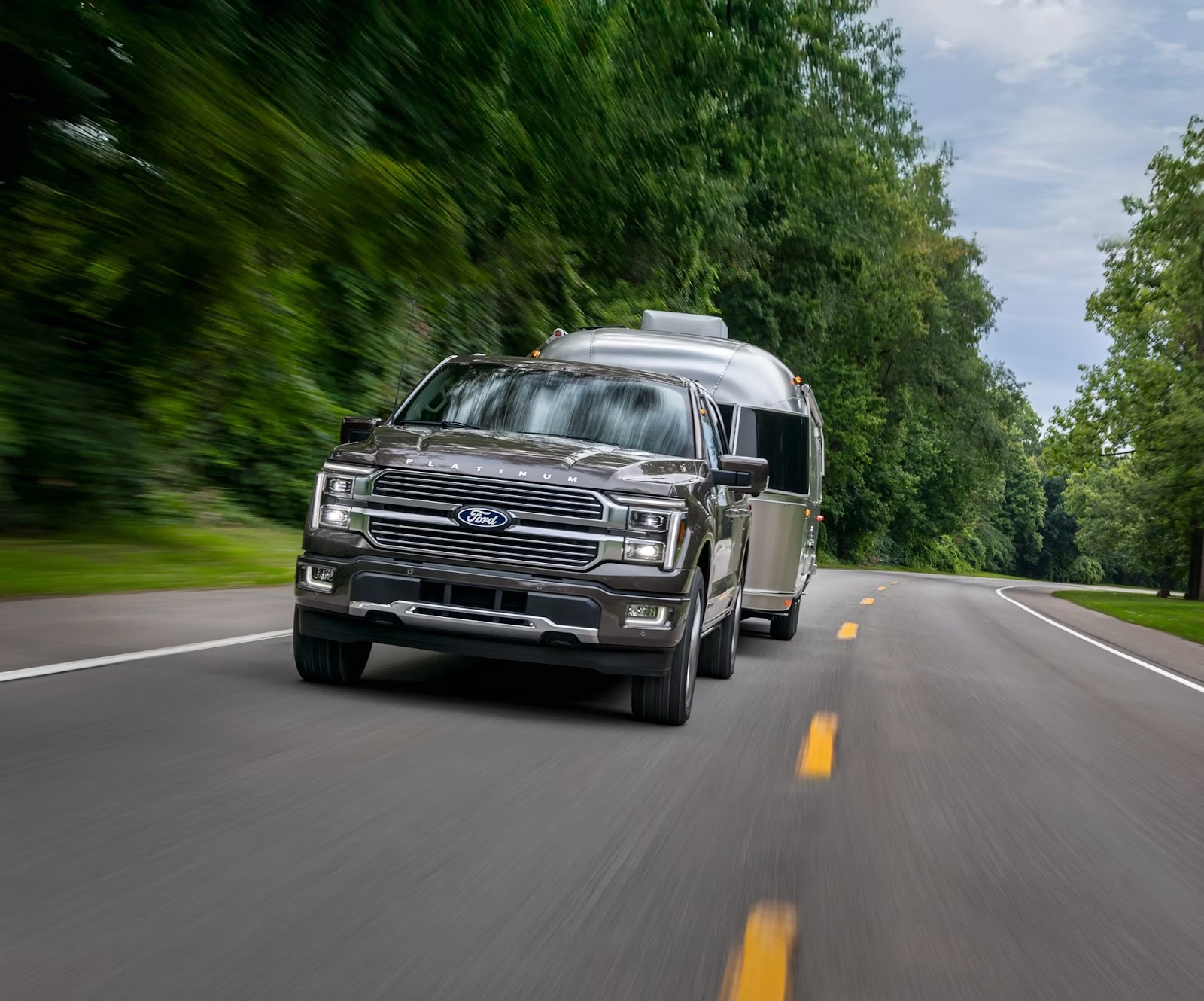
The 2026 Ford F-150 with 3.5L EcoBoost V6 delivers best-in-class 13,500 lbs maximum conventional towing capacity
Complete 2026 F-150 Towing Capacity Chart
Towing capacity isn't just about the engine—your truck's configuration plays an equally important role. The combination of cab style, bed length, drivetrain (4x2 vs 4x4), axle ratio, and installed packages determines your actual towing rating. The chart below shows maximum conventional towing capacity for key configurations across the F-150 lineup.
| Engine | Configuration | Max Towing (lbs) | Required Equipment |
|---|---|---|---|
| 3.5L EcoBoost V6 | SuperCrew 4x4 6.5' box | 13,500 | 3.55 axle + Tow/Haul + Max Tow Axle |
| 3.5L EcoBoost V6 | SuperCrew 4x2 6.5' box | 13,300 | 3.55 axle + Tow/Haul + Max Tow Axle |
| 5.0L V8 | SuperCrew 4x4 6.5' box | 12,800 | 3.73 axle + Tow/Haul + Max Tow Axle |
| 3.5L PowerBoost Hybrid | SuperCrew 4x4 6.5' box | 11,600 | 3.73 axle + Tow/Haul + Max Tow Axle |
| 3.5L EcoBoost V6 | SuperCrew 4x4 5.5' box | 10,500-10,900 | 3.55 axle (without Max Tow) |
| 2.7L EcoBoost V6 | Regular Cab 4x2 | 8,400 | 3.73 axle |
| 2.7L EcoBoost V6 | SuperCrew 4x4 5.5' box | 8,000-8,200 | 3.73 axle |
How Cab and Bed Configuration Affects Towing
The SuperCrew cab with 6.5-foot bed represents the optimal configuration for maximum towing capacity. This setup provides the best balance of weight distribution and structural strength for heavy trailer loads. Regular Cab models, while lighter, don't achieve the same maximum ratings because they lack the extended wheelbase that improves stability under load. SuperCab configurations fall in the middle, offering more passenger space than Regular Cab while maintaining respectable towing numbers.
Bed length matters more than many buyers realize. The 6.5-foot box provides better weight distribution for conventional towing compared to the 5.5-foot bed, which is why Ford's maximum ratings require the longer bed. The 8-foot bed, available on Regular Cab and SuperCab models, adds overall length but doesn't increase towing capacity beyond what the 6.5-foot achieves. For Albuquerque drivers who need to navigate tight parking lots or urban streets, the 5.5-foot bed offers better maneuverability while still delivering strong towing performance in the 10,000-11,000 lb range with the right engine.
4x2 vs 4x4 Drivetrain Impact
Four-wheel drive adds approximately 200-400 pounds to your truck's curb weight, which slightly reduces maximum towing capacity compared to 4x2 models. However, 4x4 provides crucial traction advantages when launching boats at ramps, navigating unpaved roads to camping sites, or dealing with New Mexico's occasional winter weather. Most buyers find the towing capacity difference negligible—typically 200 lbs or less—while the added capability of 4x4 proves valuable in real-world situations. At Power Ford, we help you weigh these trade-offs based on where and how you'll actually use your truck.
What Albuquerque Drivers Need to Know About Towing Packages
The advertised maximum towing capacity of 13,500 lbs requires specific equipment packages that aren't standard on all F-150 models. Understanding which packages unlock higher ratings—and which trims include them—prevents disappointment when you discover your truck can't tow as much as you expected. The two critical packages are the Tow/Haul Package and the Max Tow Axle upgrade.
The Tow/Haul Package (option code 53T) serves as the foundation for serious towing capability. This package includes an integrated trailer brake controller, upgraded cooling systems, and either a 3.55 or 3.73 electronic locking rear axle depending on your chosen engine. Without this package, most F-150 configurations top out around 8,000 to 11,000 lbs even with the powerful 3.5L EcoBoost engine. The Tow/Haul Package is optional on XL, STX, XLT, Lariat, and Tremor models (with 401A equipment group), while it comes standard on King Ranch and Platinum trims. Check out the available 2026 F-150 trim levels to see which configuration fits your needs.
Max Tow Axle: The Key to 13,500 lbs
The Max Tow Axle upgrade takes capability one step further. This option upgrades the standard 2-inch hitch receiver (rated at 11,600 lbs) to a reinforced 2-inch receiver rated at 14,000 lbs. It also includes an upgraded rear axle ratio optimized for heavy loads. To reach the maximum 13,500 lbs conventional towing capacity, Ford requires BOTH the Tow/Haul Package AND the Max Tow Axle upgrade. This isn't optional—it's a stated requirement in Ford's official towing guide.
Ford's warranty documentation makes this clear: for trailers over 11,600 lbs on gas F-150 models, you need the Tow/Haul Package and Max Tow Axle. For hybrid models, this threshold drops to 10,800 lbs. Towing above these limits without the required equipment may void your New Vehicle Limited Warranty. When you're configuring your F-150 at Power Ford, our sales team ensures you get the right packages for your intended use. We can also verify the equipment on any used F-150 in our inventory by pulling the build specifications using the VIN. Call us at (505) 234-1131 to discuss which configuration meets your towing needs.
Axle Ratios Explained
Your axle ratio determines how engine power translates to wheel rotation, directly affecting towing performance and fuel economy. The 2026 F-150 offers several ratios: 3.15, 3.31, 3.55, 3.73, and 4.10 (Raptor only). Higher numerical ratios like 3.73 multiply engine torque more effectively, providing better pulling power when accelerating or climbing grades with a heavy trailer. Lower ratios like 3.15 or 3.31 optimize highway fuel economy for unloaded driving but sacrifice maximum towing capacity.
The 3.55 axle ratio represents a strong middle ground, offering good towing capability while maintaining reasonable fuel efficiency. The 3.73 ratio is typically required for maximum towing ratings and comes standard with the Tow/Haul Package on most configurations. You can find your truck's axle ratio on the Safety Compliance Certification Label inside the driver-side door jamb—look for the word "AXLE" followed by a two-digit code. Our service team at Power Ford can also identify your axle ratio if you're unsure about your current truck's configuration.

Understanding both payload and towing capacity ensures safe hauling—tongue weight counts against your payload rating
Understanding Payload Capacity and Tongue Weight
Towing capacity tells only half the story. Your truck's payload capacity—the maximum weight you can carry in the bed and cab—directly limits how much you can safely tow. This often-overlooked specification becomes the real limiting factor for many towing scenarios, especially with conventional bumper-pull trailers.
Payload includes everything inside and on your truck: passengers, cargo in the bed, toolboxes, bed liners, and critically, the tongue weight of your trailer. Ford recommends tongue weight should equal approximately 10% of your total loaded trailer weight for conventional towing (15% for fifth-wheel applications). This means a 10,000 lb trailer should have roughly 1,000 lbs of tongue weight pressing down on your hitch—and that 1,000 lbs counts directly against your available payload.
2026 F-150 Maximum Payload by Engine
The 2026 F-150 offers maximum payload capacity of 2,440 lbs with the 3.5L EcoBoost V6 in a Regular Cab 4x2 configuration with 8-foot box. However, most buyers choose SuperCrew configurations, which have lower payload ratings due to increased cab weight. The 5.0L V8 delivers up to 2,235 lbs max payload, while the PowerBoost Hybrid tops out around 1,740 lbs due to the additional weight of the hybrid battery system.
| Engine | Max Payload (lbs) | Typical SuperCrew Payload | Notes |
|---|---|---|---|
| 3.5L EcoBoost V6 | 2,440 | 1,800-2,100 | Best overall capacity |
| 5.0L V8 | 2,235 | 1,700-2,000 | Strong for contractors |
| 3.5L PowerBoost Hybrid | 1,740 | 1,500-1,700 | Battery weight reduces capacity |
| 2.7L EcoBoost V6 | 1,775 | 1,400-1,600 | Adequate for light use |
The Real-World Payload Math
Here's a practical example that catches many buyers off guard: You're towing a 10,000 lb loaded travel trailer with a SuperCrew F-150 that has 1,900 lbs payload capacity. The trailer's tongue weight is 1,000 lbs (10% of trailer weight). Add a driver (200 lbs), passenger (180 lbs), and 200 lbs of gear in the bed. That's 1,580 lbs of payload consumed, leaving only 320 lbs of margin before you exceed your truck's GVWR (Gross Vehicle Weight Rating).
Now add a couple of bags, a cooler, camping chairs, and firewood—suddenly you're over your payload limit even though you're well under your towing capacity. This scenario happens frequently with the PowerBoost Hybrid, which offers excellent towing capability (11,600 lbs) but lower payload capacity (1,740 lbs max). The math simply doesn't work for heavy conventional trailers with this configuration. At Power Ford in Albuquerque, we help you run these calculations before you buy to ensure your truck truly matches your intended use. Explore your monthly payment options or contact us to schedule a consultation with our towing specialists.
Comparing 2026 F-150 Towing Capacity to Competitors
The 2026 Ford F-150's 13,500 lb maximum towing capacity leads the light-duty truck segment, outperforming key competitors from Chevrolet, Ram, and Toyota. This best-in-class rating reflects Ford's engineering focus on maximum capability without stepping up to heavy-duty truck territory. Understanding how the F-150 stacks up helps Albuquerque buyers make informed decisions when cross-shopping trucks.
| Truck Model | Max Towing (lbs) | Engine for Max Rating | Max Payload (lbs) |
|---|---|---|---|
| 2026 Ford F-150 | 13,500 | 3.5L EcoBoost V6 | 2,440 |
| 2026 Chevrolet Silverado 1500 | 13,300 | 6.2L V8 | 2,280 |
| 2026 Ram 1500 | 12,750 | 5.7L HEMI V8 | 2,300 |
| 2026 Toyota Tundra | 12,000 | 3.5L Twin-Turbo V6 Hybrid | 1,940 |
| 2026 GMC Sierra 1500 | 13,200 | 6.2L V8 | 2,250 |
Why the F-150 Leads in Towing
The F-150's advantage comes from Ford's EcoBoost technology, which delivers V8-level torque from a more efficient twin-turbocharged V6 platform. The 3.5L EcoBoost produces 500 lb-ft of torque, matching or exceeding the output of competitors' larger-displacement V8 engines while weighing less. This weight savings translates directly to higher payload and towing ratings. The F-150's high-strength aluminum-alloy body also reduces curb weight compared to traditional steel construction, creating additional capacity for trailer loads.
Competitors require larger, thirstier engines to achieve similar towing numbers. The Chevrolet Silverado needs its optional 6.2L V8 to reach 13,300 lbs, while the Ram 1500 tops out at 12,750 lbs with the 5.7L HEMI. The Toyota Tundra, despite using a hybrid powertrain, maxes out at 12,000 lbs. For Albuquerque drivers who tow frequently, the F-150's combination of maximum capability and reasonable fuel economy makes it the practical choice. You can compare these trucks side-by-side at Power Ford—we encourage buyers to test drive multiple configurations to experience the performance differences firsthand.
Real-World Towing Performance
Maximum towing capacity represents ideal conditions with minimal payload and optimal equipment. Real-world towing performance depends on factors like elevation changes, temperature, wind resistance, and trailer aerodynamics. New Mexico's varied terrain—from Albuquerque's 5,300-foot elevation to mountain passes exceeding 7,000 feet—tests towing capability more than flat highway driving. The F-150's turbocharged engines maintain power output better at altitude compared to naturally aspirated engines, which lose approximately 3% of power for every 1,000 feet of elevation gain.
Trailer frontal area also impacts real-world capability. Ford specifies frontal area limits of 55 square feet for ratings up to 7,700 lbs, 65 square feet for ratings above 7,701 lbs, and 75 square feet for fifth-wheel applications. Tall, boxy travel trailers create significant wind resistance that affects stability and fuel economy even when you're under the weight limit. Our team at Power Ford can help you evaluate whether your specific trailer matches well with different F-150 configurations based on both weight and aerodynamics.
Experience the 2026 F-150 Towing Capability at Power Ford in Albuquerque
Understanding towing specifications on paper only tells part of the story. The real test comes when you're behind the wheel, feeling how the 3.5L EcoBoost accelerates with a load or experiencing how the integrated trailer brake controller smoothly manages stopping power. At Power Ford, located at 1101 Montano Rd NE in Albuquerque, NM 87107, we invite you to visit us and experience the 2026 F-150's towing capability firsthand through a test drive with your actual trailer or a comparable load.
Our sales team specializes in helping Albuquerque-area drivers configure F-150 trucks that match their specific towing needs. We'll walk you through engine options, explain which packages unlock higher ratings, and run the payload calculations to ensure your chosen configuration handles your trailer safely. Whether you're towing a boat to Cochiti Lake, hauling a camper to Bandelier National Monument, or pulling equipment for your business around the metro area, we'll help you find the right truck for your needs. We also maintain detailed records of every F-150 in our inventory, so we can quickly identify which trucks have the Tow/Haul Package, Max Tow Axle, and specific axle ratios you need.
Beyond the initial purchase, Power Ford provides comprehensive towing support through our service department. We install genuine Ford trailer brake controllers, hitch receivers, and towing accessories. Our technicians can verify your truck's towing capacity using your VIN, check that all towing-related systems function properly, and ensure your truck is properly maintained for heavy hauling. We also offer trailer wiring installation and troubleshooting for customers who need electrical connections for their trailers. Call us at (505) 234-1131 or browse available F-150 trucks with detailed specifications.