

For most campers pulled through the mountains around Santa Fe, the best Ford truck is the 2026 F-150 with the 3.5L EcoBoost V6 — 13,500 pounds of conventional towing, 500 lb-ft of torque, and turbocharged power that holds together at 7,200 feet. Fifth-wheels need a Super Duty.
That answer comes down to two things thin air does to a tow vehicle: it robs power, and it shrinks your margin for error on long grades. A naturally aspirated V8 gives up roughly 3% of its output for every 1,000 feet of elevation, so by the time you crest Glorieta Pass it is working with about a fifth less power than the brochure promised. A turbocharged EcoBoost simply spins its turbos harder and claws most of that back. If you want the full engine-by-engine breakdown, our 2026 Ford F-150 towing capacity guide lists every rating and the equipment required to reach it, and our broader look at choosing a Ford truck or SUV for towing and off-roading in New Mexico covers the SUV and Super Duty side of the lineup.
Key Highlight
Ford's own towing guidance says to reduce gross vehicle weight and gross combination weight by 2% per 1,000 feet of elevation to match the performance you would feel at sea level. At Santa Fe's roughly 7,200 feet, that is about a 14% haircut — so treat a 13,500-pound F-150 rating as an 11,500-pound planning number when the trailer is going uphill.
This guide walks through what each 2026 Ford truck can actually pull with a camper behind it, why payload usually runs out before towing capacity does, and how elevation changes the math on the climbs between the Rio Grande valley and the Sangre de Cristos. Power Ford sits about an hour south of the Plaza on I-25 and serves camper owners across northern New Mexico — you can see the full picture of what we offer as a Ford dealership serving Santa Fe, NM, including trucks already built with the towing hardware these ratings require.
Key Takeaways
- The 2026 F-150 with the 3.5L EcoBoost V6 is the best all-around camper truck for Santa Fe: 13,500 lbs of conventional towing in SuperCrew 4x4 form with the 6.5-foot box, Tow/Haul Package and Max Tow Axle
- Ford advises cutting gross vehicle and gross combination weight by 2% per 1,000 feet of elevation — roughly 14% at Santa Fe's 7,200 feet, and that is a performance guideline, not a change to your truck's legal rating
- Turbocharged EcoBoost engines recover most altitude power loss by raising boost; a naturally aspirated V8 gives up about 3% per 1,000 feet, or close to 20% in Santa Fe
- Payload — not the tow rating — is what stops most travel-trailer buyers, because tongue weight runs about 10% of the loaded trailer and counts against the same number as passengers and gear
- Fifth-wheels and campers past roughly 12,000 lbs belong behind a Super Duty; a 2026 F-250 with the 7.3L gas V8 tows up to 22,000 lbs conventional
- Power Ford can match a truck to your camper's actual weight sticker before you buy — call (505) 933-7883
Which Ford Truck Is Best for Towing a Camper Around Santa Fe?
Start with the camper, not the truck. Weigh what you actually tow — loaded, with water in the tanks and gear in the pass-through — and the right Ford usually picks itself. Three trucks cover almost every camper sold in northern New Mexico, and the dividing lines between them are tongue weight and trailer height, not horsepower.
For the standard 24-to-30-foot travel trailer most families own, the F-150 with the 3.5L EcoBoost V6 is the answer. It carries the highest half-ton rating in the lineup, its 500 lb-ft of torque arrives low in the rev range where mountain climbing happens, and twin turbochargers mean it does not fade the way a naturally aspirated engine does above 6,000 feet. Step down to a Ranger for a small trailer and you save money without giving up much; step up to a Super Duty once a fifth-wheel hitch enters the conversation, because pin weight will bury a half-ton's payload long before it runs out of pulling power.
F-150 3.5L EcoBoost V6
13,500 lbs max tow | 2,175 lbs payload (4x4) | 400 hp / 500 lb-ft | The travel-trailer default: turbo boost offsets thin air, and Tow/Haul plus Max Tow Axle unlocks the full rating
F-250 Super Duty 7.3L Gas V8
22,000 lbs max tow | 19,500 lbs fifth-wheel | 430 hp / 485 lb-ft | The fifth-wheel and toy-hauler pick, with payload deep enough to absorb a 2,500 lb pin weight
Ranger 2.3L EcoBoost I-4
7,500 lbs max tow | 1,763 lbs payload (4x4) | 270 hp / 310 lb-ft | Right-sized for teardrops, pop-ups and single-axle trailers, and easier to park in Santa Fe's older neighborhoods
Two numbers decide whether a pairing works: the trailer's loaded weight and its tongue weight. Ford's guidance is 10% of loaded trailer weight on the tongue for a conventional hitch and 15% on the pin for a fifth-wheel, and that weight lands on your rear axle as payload. A 9,000-pound travel trailer therefore asks for about 900 pounds of payload before anyone climbs in the cab — which is why the payload column in the chart below matters as much as the tow rating next to it.
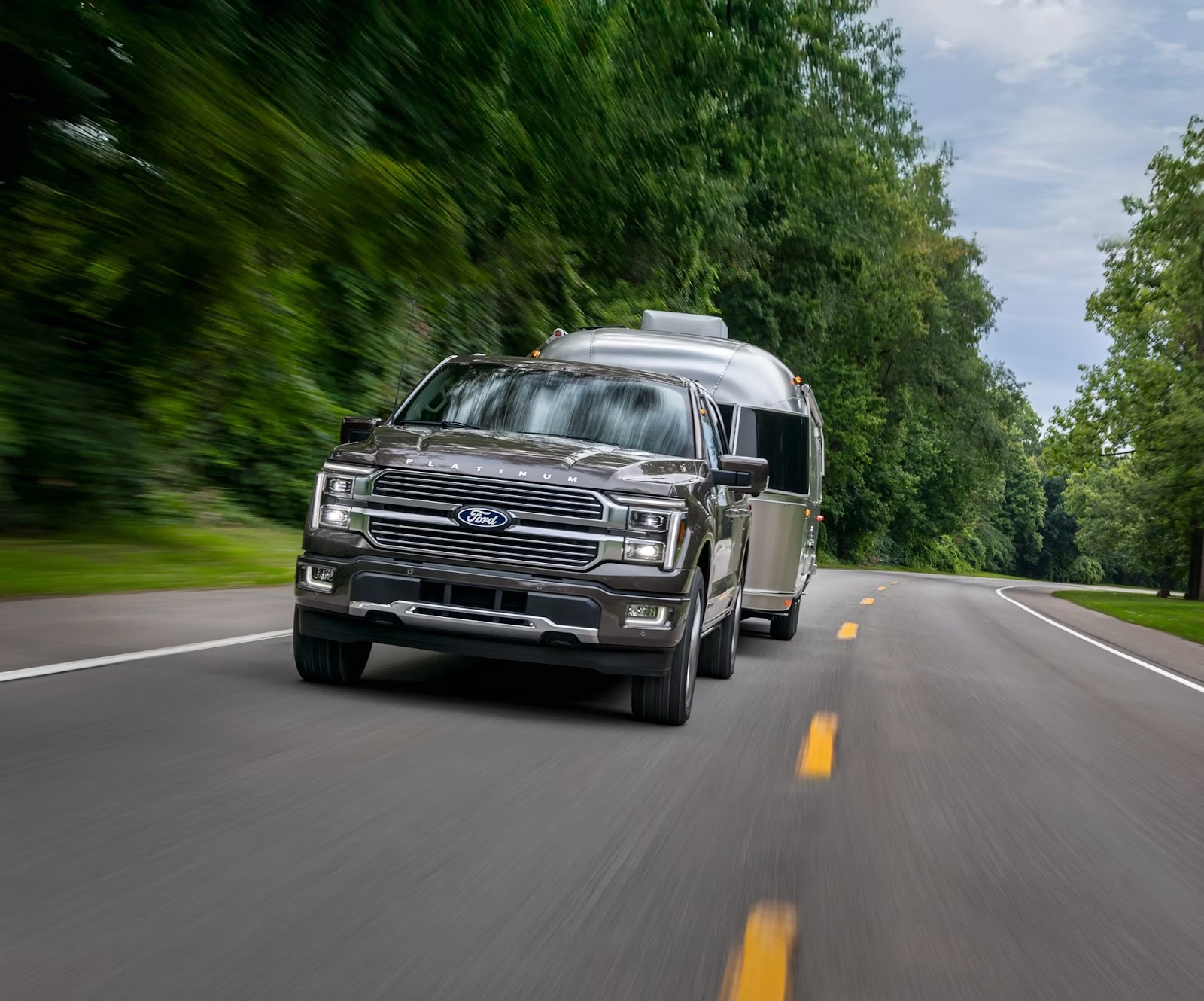
The 2026 F-150 with the 3.5L EcoBoost V6 tows up to 13,500 lbs — enough for most travel trailers on northern New Mexico grades
2026 Ford Truck Towing and Payload Comparison
The chart below pairs every relevant 2026 Ford truck engine with its maximum conventional towing capacity and its maximum payload. Four-wheel-drive figures are shown where 4x4 is the sensible choice for unpaved forest roads and winter passes, since 4x4 adds curb weight and trims both numbers slightly. Every rating assumes the truck is properly equipped — on the F-150 that means the Tow/Haul Package and the Max Tow Axle upgrade, and on Ranger and Maverick it means the Trailer Tow Package (53R) or 4K Tow Package (53Q) respectively.
| Model | Engine | Max Tow (lbs) | Max Payload (lbs) |
|---|---|---|---|
| F-150 SuperCrew 4x4 | 3.5L EcoBoost V6 (400 hp / 500 lb-ft) | 13,500 | 2,175 |
| F-150 SuperCrew 4x4 | 5.0L Ti-VCT V8 (400 hp / 410 lb-ft) | 12,800 | 2,080 |
| F-150 SuperCrew 4x4 | 3.5L PowerBoost Hybrid V6 (430 hp / 570 lb-ft) | 11,600 | 1,740 |
| F-150 4x4 | 2.7L EcoBoost V6 (325 hp / 400 lb-ft) | 8,200 | 1,715 |
| Ranger SuperCrew 4x4 | 2.3L EcoBoost I-4 (270 hp / 310 lb-ft) | 7,500 | 1,763 |
| Maverick AWD | 2.0L EcoBoost I-4 or 2.5L Hybrid | 4,000 | 1,500 |
| F-250 Super Duty Crew Cab | 7.3L Gas V8 (430 hp / 485 lb-ft) | 22,000 | 7,635 |
How Cab, Bed and Drivetrain Change the Numbers
The headline F-150 rating belongs to one specific truck: SuperCrew 4x4 with the 6.5-foot box. The longer wheelbase spreads tongue weight across a wider footprint and settles the trailer down at highway speed, which is why Ford reserves the 13,500-pound figure for that configuration. The same engine in a SuperCrew with the 5.5-foot box typically lands closer to 10,500 to 11,000 pounds — still plenty for a mid-size trailer, and noticeably easier to live with in a downtown Santa Fe parking garage.
Drivetrain costs you a little on paper and buys you a lot in practice. Four-wheel drive adds a couple hundred pounds, which is why the 4x2 3.5L EcoBoost carries a 2,440-pound payload rating while the 4x4 version carries 2,175. For anyone backing a trailer down a gravel launch at Abiquiú Lake or reaching a forest-road campsite after an August monsoon, that trade is worth making.
Reading Your Camper's Weight Sticker Correctly
Dry weight on a brochure is not the number to plan around. The figure that matters is GVWR — the most the camper is allowed to weigh fully loaded — because that is what you will be pulling by the second night of a trip. Fresh water alone runs 8.3 pounds per gallon, so a 40-gallon tank is another 330 pounds. Plan against GVWR, keep the trailer's frontal area under the 65-square-foot limit Ford sets for ratings above 7,701 pounds, and the truck will not surprise you on a grade.
Payload and Tongue Weight Stop More Camper Buyers Than Tow Ratings Do
Almost every camper owner who feels let down by a half-ton truck ran out of payload, not towing capacity. Payload is everything the truck carries rather than pulls: driver, passengers, dogs, firewood, the bed-mounted toolbox, the weight-distribution hitch itself — and the camper's tongue weight pressing down on the ball. All of it counts against one number on the sticker inside the driver's door jamb.
That sticker is the authority, not the brochure. Two F-150s on the same lot with the same engine can differ by 300 pounds of payload depending on trim, sunroof, seats and wheels. A loaded Platinum with the panoramic roof simply has less left over for a trailer than an XLT with the same drivetrain, which is why the payload conversation should happen before the trim conversation.
Where Tongue Weight Actually Lands
Ford's guidance is straightforward: tongue load of 10% of loaded trailer weight for conventional trailers over 2,000 pounds, capped at 200 pounds for trailers under 2,000 pounds, and 15% on the king pin for a fifth-wheel. Run the multiplication before you shop. A 9,500-pound travel trailer means roughly 950 pounds on the hitch; a 14,000-pound fifth-wheel means about 2,100 pounds on the pin, which is more than most half-ton payload ratings allow on their own.
The available Onboard Scales with Smart Hitch on the F-150 makes this concrete instead of theoretical. It estimates payload and tongue weight and shows them in the taillamps, on the center screen or in the FordPass app, so you can adjust where gear sits in the trailer rather than guessing. For repeat camper trips out of Santa Fe, it is one of the more genuinely useful options on the order sheet.
A Real Santa Fe Payload Example
Say you own a 9,000-pound loaded travel trailer and you are looking at an F-150 SuperCrew 4x4 with the 3.5L EcoBoost and 2,175 pounds of payload. Tongue weight at 10% is 900 pounds. Add two adults at 380, a weight-distribution hitch at 100, two kids and a dog at 220, and 150 pounds of camp gear in the bed. That is 1,750 pounds committed, leaving roughly 425 pounds of headroom — comfortable, but not unlimited.
Now run the same trailer behind a PowerBoost Hybrid at 1,740 pounds of payload and the headroom drops to under 150 pounds before the cooler and firewood go in. The hybrid tows the trailer without complaint; it is the payload that gets tight, because the battery pack occupies capacity a gas truck spends on cargo. That distinction is exactly the kind of thing worth settling in person with a tape measure and a weight sticker instead of discovering at the campground.

Tongue weight counts against payload, so the sticker in your door jamb — not the brochure — decides which camper fits
How Santa Fe's 7,200 Feet Changes What You Can Actually Tow
Towing ratings are published for conditions that do not exist in northern New Mexico. Thin air carries less oxygen, so an engine makes less power, the cooling system works harder, and the transmission spends longer in lower gears. None of that changes the number Ford prints for your truck — it changes how much of that number you can lean on when the road tilts uphill for eight miles.
Ford addresses this directly in its towing documentation rather than leaving it to folklore. According to Ford's 2026 RV & Trailer Towing Guide, drivers should reduce gross vehicle weight and gross combination weight by 2% per 1,000 feet of elevation in order to match the driving performance they would perceive at sea level. Santa Fe sits at roughly 7,200 feet, and Glorieta Pass just east of town runs close to 7,500, so the derate is real for anyone who camps locally.
Ford's 2% Per 1,000 Feet Guideline, Applied to Real Ratings
Applying that guideline to Santa Fe elevation gives a planning figure roughly 14% below the published rating. These are not revised legal capacities — your truck's rating and GVWR do not move — but they are honest numbers to shop against if most of your towing happens above 7,000 feet rather than on flat interstate.
| F-150 Engine (4x4) | Published Max Tow (lbs) | Planning Figure at 7,200 ft (lbs) | What That Covers |
|---|---|---|---|
| 3.5L EcoBoost V6 | 13,500 | ~11,550 | Most travel trailers up to 32 feet |
| 5.0L Ti-VCT V8 | 12,800 | ~10,950 | Mid-size trailers, with more downshifting |
| 3.5L PowerBoost Hybrid V6 | 11,600 | ~9,900 | Mid-size trailers; payload limits it first |
| 2.7L EcoBoost V6 | 8,200 | ~7,000 | Small trailers, pop-ups and utility loads |
Why Turbocharged EcoBoost Engines Hold Power on Grades
A naturally aspirated engine breathes whatever air the atmosphere hands it, and at 7,200 feet that is roughly a quarter less air than at sea level — the familiar rule of thumb is about 3% of power lost per 1,000 feet, which puts a 5.0L V8 down close to a fifth of its rated output before you even hitch up. A turbocharged engine is not at the mercy of ambient pressure in the same way. The turbos simply spin faster and raise boost to restore intake pressure, so the 3.5L EcoBoost arrives at Glorieta Pass with far more of its 500 lb-ft intact.
You feel it as fewer downshifts, lower coolant and transmission temperatures, and a truck that holds 60 mph up La Bajada Hill instead of surrendering to traffic. Pair that with Tow/Haul mode, which sharpens shift logic and adds engine braking on the way back down toward the Rio Grande, and the difference between a turbo and a naturally aspirated V8 on New Mexico grades is much larger than the spec sheet suggests. Details on the rest of the system — the integrated trailer brake controller, Pro Trailer Backup Assist and the Smart Trailer Tow Connector — are documented on Ford's F-150 towing and hauling overview.
Matching Your Camper to the Right Ford Truck
Campers sort neatly into weight bands, and each band has a Ford that handles it without drama. The table below pairs the common camper types towed around northern New Mexico with the truck that fits, along with the tongue or pin weight you should budget for in your payload calculation.
| Ford Truck & Engine | Camper Types It Fits | Typical Loaded Weight (lbs) | Tongue or Pin Weight (lbs) |
|---|---|---|---|
| F-150 4x4, 3.5L EcoBoost V6 | Travel trailers 24–32 ft, light toy haulers | 6,000–11,500 | 600–1,150 |
| F-150 4x4, 5.0L Ti-VCT V8 | Travel trailers up to about 30 ft | 5,000–10,000 | 500–1,000 |
| F-150 4x4, 3.5L PowerBoost Hybrid | Mid-size trailers where campsite power matters | 4,000–8,000 | 400–800 |
| Ranger 4x4, 2.3L EcoBoost I-4 | Teardrops, pop-ups, single-axle trailers | 1,500–7,000 | 150–700 |
| F-250 Super Duty, 7.3L Gas V8 | Fifth-wheels, large toy haulers, dual-axle rigs | 12,000–19,500 | 1,800–2,900 |
The Towing Hardware to Insist On Before You Hook Up
Maximum ratings are equipment-dependent, and the equipment is what makes mountain towing pleasant rather than tense. On the F-150 the Tow/Haul Package brings the integrated trailer brake controller, upgraded cooling and an electronic-locking rear axle in either a 3.55 or 3.73 ratio. The Max Tow Axle upgrade goes further, reinforcing the receiver and optimizing the axle for heavy loads — and Ford requires both to reach 13,500 pounds. Without them, the same engine typically tops out in the 10,500-to-11,000-pound range.
The numerically higher axle ratio is worth asking about specifically. A 3.73 multiplies torque more effectively for climbing and pulling away from a stop on a grade, while a 3.15 or 3.31 favors unloaded highway economy. You can read your own truck's ratio off the Safety Compliance Certification Label in the driver's door jamb, and our team can decode it from a VIN on any truck in stock — useful when you are comparing two trucks that look identical on the window sticker.
Why the Raptor Isn't the Camper Hauler
It is a reasonable question, because the Raptor is the most capable-looking F-150 on the lot. Its long-travel Fox suspension and wide track are tuned for absorbing desert whoops at speed, which is the opposite of what a trailer wants. Softer, longer-travel springs allow more squat under tongue weight and more porpoising at highway speed, and the Raptor's payload and tow ratings come in well below a Tow/Haul-equipped 3.5L EcoBoost F-150.
That does not make it the wrong truck — it makes it a different truck. If your weekends are about trails rather than trailers, our look at buying a new Ford F-150 Raptor for off-roading covers where it genuinely excels. For pulling a camper up to Hyde Memorial State Park, a properly equipped standard F-150 is both cheaper and better at the job.
Match Your Camper to the Right Truck at Power Ford
Numbers on a page only go so far — the test that settles it is hooking your own trailer to a candidate truck and driving it up a grade. Power Ford is at 1101 Montaño Rd NE in Albuquerque, NM 87107, roughly an hour south of the Santa Fe Plaza on I-25, and we encourage camper owners to bring the trailer along. Feeling how the integrated trailer brake controller modulates on a descent, or how little the 3.5L EcoBoost has to downshift on a climb, tells you more than any spec sheet.
Bring your camper's weight sticker and our team will do the arithmetic with you: GVWR against tow rating, tongue weight against payload, axle ratio and packages verified from the VIN of real trucks on the lot rather than a configurator. We will tell you honestly when a half-ton is the right answer and when a Super Duty is, and we will show you which trucks in stock already carry the Tow/Haul Package and Max Tow Axle. We'll beat any Ford deal in New Mexico, or you'll get $1,000 cash in your pocket.
Support does not end at delivery. Our service department installs genuine Ford hitch receivers, brake controllers and trailer wiring, diagnoses trailer electrical faults, and keeps cooling systems and transmissions maintained for the kind of sustained climbing northern New Mexico asks of a tow vehicle. Call (505) 933-7883 to set up a towing consultation or a test drive with your trailer. If you've already visited Power Ford, please leave us a review!